Lab Source Peptidess: Raw Material Sourcing & Community Discussion Archive
Lab Source Peptidess is a phrase that circulates in research supply discussion, and this page exists to record what can be observed about it in public sources. The archive covers three things: where peptide raw material is said to come from, how open communities discuss that sourcing, and how those communities talk about whether a supplier can be relied upon. Everything here is drawn from material already published on the open web. Nothing has been requested from any supplier, nothing has been analysed in a laboratory here, and no commercial arrangement stands behind a single line on this page.
The word source is the part of the phrase that causes confusion, so the archive fixes its meaning at the start. Source refers to the route by which peptide raw material is produced and the channel through which it reaches a laboratory bench: the assembly or expression route behind it, the purification step that follows, the documentation attached to a batch, and the distributor named on a listing. Source does not refer to a specific molecule. No compound is described, catalogued or evaluated anywhere on this site, and the absence of names here is deliberate rather than accidental.
Three boundaries run through the whole page. This site is independent: it holds no affiliation with any supplier, accepts no placement, and keeps no commercial relationship on record. It does not assess material quality, does not compare operators, produces no ranking, and carries no guidance that would help a reader acquire anything. Research peptides are not approved for use in humans, and no route, amount or schedule of administration to humans appears anywhere here. What the site does is narrower and more durable: it keeps a dated record of what has been published, and it says plainly how far that record can be trusted.
All content on this page aggregates publicly available web information about lab Source Peptidess for research reference only. This site is not affiliated with any peptide supplier and does not provide medical advice, vendor endorsement, or purchasing guidance.
Top Page Short Disclaimer
All content on this page aggregates publicly available web information about lab Source Peptidess for research reference only. This site is not affiliated with any peptide supplier and does not provide medical advice, vendor endorsement, or purchasing guidance.
What Are Lab Source Peptidess? Raw Material Source Overview
Read as an ordinary research term, a lab Source Peptides is a peptide material obtained for laboratory work and described by its specification rather than by any consumer identity. In that sense the phrase belongs to sourcing language: it says something about where a laboratory got its starting material and what paperwork came alongside it. What it does not do is describe a class of molecules. Two materials sharing a chain length and a residue sequence can carry entirely different documentation depending on how they were assembled, purified and released, so a sourcing label carries no information about identity beyond what the batch record states.
The basic science behind the material is worth stating once, because most of the confusion in public discussion comes from skipping past it. A peptide is a short chain of amino acids held together by amide bonds, shorter than a protein and usually defined by its residue count and by sequence. Because that sequence determines how the chain folds and what it can bind to, the usefulness of a research material depends on whether the chain is the one stated on the label, whether it is intact along its length, and whether anything else travelled with it through purification.
Getting to that point takes a chain of steps that public discussion rarely separates. Assembly builds the chain on a support or in solution, one residue at a time. Cleavage releases it and removes the protecting groups used during assembly. Purification, most often preparative chromatography, separates the intended chain from shorter ones that failed to complete assembly. Isolation turns the purified fraction into a stable solid, usually by lyophilisation, and documentation records what the analytical work showed for that batch. A problem at any step changes the material without changing how the listing reads.
For all of that, this page describes no application and no outcome. A specification states what a batch contains and how precisely that is known. It does not state what the material does in an experiment, and it says nothing at all outside that frame. The archive records specification vocabulary, because that is what a reader actually encounters in a listing, and it stops before any statement about what a material might be applied to.
| Description in public discussion | What the description usually refers to | How this archive records it |
|---|---|---|
| Lyophilised powder | Solid material isolated by freeze drying after purification, the physical form most often listed for laboratory material | Recorded as a physical form descriptor; no claim about stability or handling is attached |
| Purity stated as a percent figure | The share of material behaving as the intended chain under one analytical method, usually a chromatographic one | Recorded as a figure reported in documentation; not checked against any batch, not compared between listings |
| Certificate of analysis | A batch document reporting selected analytical output, issued by the producer or by a contracted laboratory | Recorded as a document type; whether it belongs to the batch accompanying it is not something this site checks |
| Sequence and chain length | The residue sequence and residue count stated for the material, the basic identity description in any listing | Recorded as identity vocabulary in general terms; no compound is named anywhere on this site |
| Research grade label | A trade descriptor meaning the material was released for laboratory work and not as a medicinal product | Recorded as a labelling convention with regulatory meaning; not read as a statement of analytical depth |
| Batch or lot code | A producer identifier intended to trace one batch back through production and release records | Recorded as a traceability field type; no code belonging to any supplier is reproduced |
What Lab Source Peptides Means as a Research Raw Material Term
The singular form deserves its own note, because it carries a different meaning from the plural. A phrase such as lab Source Peptides points at a category of material described by how it was obtained. Readings that take it for a brand or for one particular organisation are misreadings, and they spread easily because search engines return whichever interpretation matches the surrounding words. Nothing prevents several operators from using the same descriptive phrase in their own copy, and that is what tends to happen with a generic sourcing term.
This archive therefore fixes the term to one reading and states it explicitly: a descriptor for laboratory raw material and for the route by which it arrives, not an organisation, not a product line, and not a compound. Where a public page uses the phrase differently, that page is recorded under the meaning it used rather than folded into this one. Where a search term combines the phrase with a supplier name or another compound name, the combination is noted as search behaviour and the subject is not expanded into it, because stretching coverage to fit a search term turns an archive into a catalogue.
Public Community Discussion of Lab Source Peptidess
Open communities are where most discussion of peptide sourcing happens, and Reddit is the largest English-language venue for it. Threads there cover which operators are being talked about in a given period, how documentation is worded, whether a lot code format has been seen before, and how long deliveries took. The discussion exists, it is substantial, and it is worth recording as discussion. It is not worth reading as measurement, because the accounts producing it are anonymous, unverified, and free to be mistaken, invested, or invented.
The archive keeps one narrow rule with this kind of material. It records that a topic is discussed, roughly how persistent that topic is, and what kind of source the discussion comes from. It does not adopt what any thread concluded, does not weigh one thread against another, does not score anything, and does not link to any specific post. A link would send readers to a single unverified account and would imply endorsement of the venue, and a score would turn weakly sourced commentary into something that looks authoritative without becoming any better sourced.
- Thread existence and topic are recorded; thread conclusions are not adopted.
- Posting accounts are handled as unidentified, since independence from any supplier cannot be assumed in either direction.
- Repeated claims are recorded as repeated, which is a statement about discussion volume rather than about accuracy.
- No thread is cited by URL and no community is endorsed, quoted or summarised as an authority.
- No rating, score, ranking or summary verdict is produced from community material, however detailed that material looks.
- Specialist communities and general ones are handled under the same rule, whatever the technical depth of either.
Lab Source Peptidess Review: How Public Commentary Is Collected
Searches for lab Source Peptidess review material usually return three different kinds of source mixed together: testimonials hosted on an operator's own page, rating widgets on directory sites, and open forum threads. These are not variations of one thing. Hosted testimonials are selected by whoever hosts them. Directory ratings are frequently unmoderated and can be submitted by anyone at all. Forum threads are unedited but anonymous. Averaging three weak sources into one figure does not strengthen them; it hides three separate weaknesses behind a single number that looks independent.
What the archive does instead is classify. Each item of commentary is recorded by source type, by the operational topic it addresses, and by whether the same topic appears elsewhere in public under an account with a different posting history. A claim that appears once is one observation about what people say. The same claim appearing across unrelated accounts over several months is a pattern in discussion. Neither becomes a finding about any operator, and the gap between the two is stated wherever it changes how the record should be read.
Lab Source Peptidess Reddit Discussion Threads
The search phrase lab Source Peptidess reddit reflects where the discussion actually lives. General communities carry the widest volume, while specialist boards carry longer and more technical threads written by accounts with a posting history in the subject. Both are public and searchable, and both accept anonymous participation, so neither verifies who is writing. The archive applies one rule to both: it records that the discussion exists and its rough volume, adopts no individual claim, and links no thread.
That caution has a practical basis. A forum thread is evidence that somebody wrote something, on a date, under an account whose independence is unknown. It is not evidence about the material or the organisation discussed. Reading it as a finding is how a supplier rumour hardens into a supplier fact, because forum commentary reads fluently and gets repeated often. This page will not perform that conversion.
Public Discussion on Lab Source Peptides Supplier Legitimacy
Whether a supplier can be relied upon is the question most readers bring to this topic, and it is the question open discussion frames least carefully. Public threads tend to compress several distinct checks into one short word, as though a single answer covered documentation quality, batch consistency, operator identity and whether a storefront is still trading at all. Those are separate questions resting on separate evidence, and collapsing them produces a verdict that no individual claim in the thread actually supports.
The dimensions below are the ones that recur across open discussion, listed in the form they take in public. Each is something a reader can look for in published material. None is something this archive can confirm about any operator, because confirming any of them requires access to primary records, to a producer's own quality system, or to an analytical output generated for one specific batch, and this site has none of those things.
What this site can say about supplier legitimacy is limited to a statement about discussion. It can record which dimensions people raise and how they weigh them. It cannot verify any dimension for any organisation, does not check a certificate against a batch, and holds no record that would allow one operator to be placed above another. Certainty requires primary records held by the producer.
- Certification claims: stated conformity with a recognised quality standard, usually shown as a badge or a scanned document on a listing.
- Independent analytical reports: work carried out by a laboratory outside the producer, showing what was tested and by which method.
- Batch traceability: a code or record allowing one batch to be followed back through production, release and distribution.
- Published contact detail: a physical address, an operating identity, and a route that reaches a responsible party.
- Operating history: how long the same name has been visible publicly, and whether that visibility has been continuous or interrupted.
- Documentation consistency: whether certificate wording, lot format and the analytical methods reported stay stable across listings and across time.
Lab Source Peptidess Legit: What the Public Discussion Actually Covers
The phrase lab Source Peptidess legit turns up in searches because readers want a short answer to a long question. What the discussion covers is narrower than that phrase implies. Thread content concentrates on whether a published certificate looks complete, whether a lot code format matches what the same organisation published earlier, whether a domain has stayed stable, and whether anyone reports having received material. Those are documentation and continuity observations, and anyone can make them from public material, including by the method used here.
What they do not cover is anything requiring analytical work. Whether a certificate reflects the batch it was issued alongside, whether a reported purity figure came from the method claimed, and whether a material meets the specification printed beside it cannot be settled from a listing or from a thread. The archive records the discussion and the dimensions it turns on, says nothing about whether any organisation meets or fails any dimension, and offers no verdict of any kind. That position is not caution for its own sake; it is the only position an open record of public claims can honestly hold.
Peptide Raw Material Sourcing Fundamentals
Peptide raw material reaches a laboratory through one of a small number of production routes, and the route shapes everything downstream: which impurities are plausible, which analytical methods are appropriate, and which documentation is meaningful. Several routes account for nearly all research material discussed in public, and they are set out below in the terms the open literature uses.
Each route leaves a characteristic fingerprint in the impurity profile, which is why the route matters more than the wording on a listing. Failed couplings in stepwise assembly leave shorter chains differing from the target by one residue or by a run of them, and those species may survive purification alongside the target. Incomplete removal of protecting groups leaves modified variants. Host-based routes raise the question of residual host protein and deoxyribonucleic acid content. Solvents, reagents and counter-ions persist in the isolated solid unless deliberately removed.
Grading is where labelling and reality most often diverge in public talk. Research grade and pharmaceutical grade are trade descriptors rather than points on one measured scale, and how strictly any organisation applies them varies. The distinction behind them concerns the quality system: what gets tested on every batch, which methods are validated, what limits are set for related impurities, for residual solvent and for counter-ion content, whether microbial contamination and bacterial endotoxin are measured, and whether a qualified person signs the batch into release.
Two further concepts recur in public discussion and are worth defining once, because they are used as if they were interchangeable with quality. Identity is whether the chain carries the residue sequence stated. Purity is the share of the material, normally reported as a percent for one analytical method, that behaves as that chain under that method. A figure from one method is not the whole composition, which is why the method matters: chromatographic output and mass-based identity confirmation answer different questions, and neither addresses water content, counter-ion load, endotoxin or microbial presence.
A material released for laboratory work has therefore not passed through the release pathway required of a medicinal product, and no wording in a listing changes that. Readers comparing two listings are usually comparing two descriptions of paperwork rather than two sets of measurements, and this archive will not convert descriptions of paperwork into a comparison of material.
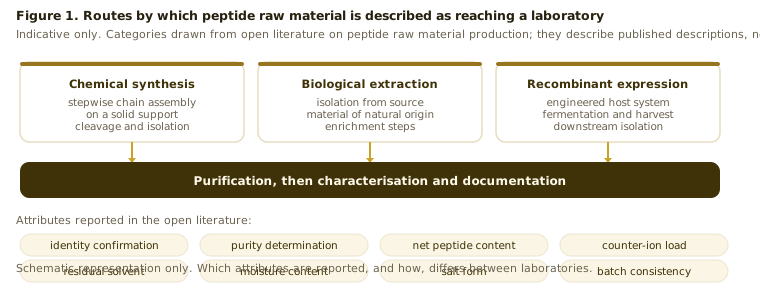
| Production route | How the material is produced | Documentation and characteristics commonly discussed |
|---|---|---|
| Stepwise solid-phase assembly | The chain is built one residue at a time on an insoluble support, then cleaved and purified | Routine for defined sequences; impurity discussion centres on shorter chains and incomplete deprotection |
| Solution-phase assembly | Fragments are coupled in solution and then joined, historically common for shorter chains and for larger scales | Fewer cumulative coupling steps per fragment; impurity discussion centres on fragment remnants and racemisation |
| Fragment ligation approaches | Purified fragments are joined chemoselectively to reach lengths that stepwise assembly struggles to reach | Enables longer chains; documentation usually reports additional identity confirmation steps |
| Recombinant expression | A host organism expresses the sequence from an introduced construct, followed by capture and polishing steps | The host system introduces residual host protein and nucleic acid questions into impurity discussion |
| Isolation from biological material | Peptides present in a tissue or fermentation source are extracted and enriched | Composition is source dependent and less uniform; identity rests heavily on enrichment and characterisation |
Peptide Lab: Sourcing Routes Recorded in Public Literature
The search phrase peptide lab usually points at a different question from the one this topic answers: where the analytical work behind a material was carried out. In open literature the route from raw material to a documented batch runs through several environments, the assembly facility, the purification and characterisation laboratory, and, for material produced biologically, the expression facility. Each keeps its own records, and each can be a separate organisation from the one whose name appears on a listing.
That separation explains a recurring feature of open discussion. A listing can carry detailed analytical output while the organisation named on it carried out none of the work, because the work was contracted out. A lot code can belong to a repacker rather than to a producer. A certificate can be authentic and still describe a batch other than the one in front of a reader. None of those are allegations against anyone, and none are attached here to any organisation; they are structural features of a chain in which several parties handle material and one name reaches the reader.
What Are Sources of Peptides
Asked directly, that question has answers at two levels. At the material level, peptides originate either by chemical assembly from amino acid building blocks, by expression in a biological host, or by isolation from biological material followed by enrichment. At the practical level that matters to a laboratory, a source is the specific combination of producer, purification and release pathway, documentation set and distributor standing behind the batch under consideration. Two batches sharing a sequence can trace back to different sources while carrying identical descriptions.
This archive keeps both levels in view and commits to neither beyond what is published. It describes routes and documentation types as general concepts drawn from open literature, records how those concepts are discussed publicly, and names no producer, no facility and no distributor. Nothing here identifies where any batch of any material came from.
Editor & Review Information
Content aggregated from long-term observation of publicly available industry records, open web sources and community discussion about lab Source Peptidess. Nothing here has been independently verified against a primary commercial record, no product has been ordered or tested, and every summary is published together with the limitation statement that qualifies it.
Every page in this archive is assembled and checked under one written procedure. Review runs quarterly: on each pass the editor re-examines the public record, rechecks whether statements recorded here still appear in the sources they were taken from, and notes what the open discussion currently covers. Entries carry two names, the author who assembled the record and the reviewer who checked it against the stated sources, and both are set out below.
| Written by | Peptide Raw Material Research Editor |
| Reviewed by | Biomedical Information Reviewer |
| Last updated | 2026-09-16 |
| Scope | Public quality-trait literature on research-grade peptides |
| External citations | Public research records (PubMed / NCBI) |
Information Limitations & Research Methodology
Four limits apply to everything above, and they are collected here rather than repeated in every sentence. The material is second-hand: no primary business record, no production record and no release record has been consulted. Nothing has been measured here: no material was obtained, no sample was analysed, and no certificate was checked against a batch. The public record moves faster than a static page can follow, so any detail on this page may already be out of date.
The method is deliberately narrow, because a narrow method survives contact with its own limitations. Each pass collects field types rather than values, attaches a source type to every field, and records the date on which that field was observed. Identical wording appearing across unrelated directory pages is counted once and marked as duplicated, since repetition is not independence. Contradictions between sources are recorded as contradictions rather than settled, and claims about material quality are recorded as claims and left at that.
Two consequences deserve to be stated plainly, because they are the ones readers most often misread. Absence here is not evidence of absence anywhere else: a detail missing from this page may simply never have been published in a source this archive reached. And nothing on this page supports a conclusion about any organisation, any batch or any material, because an archive records what has been said in public rather than what has been established.
The policy of naming no compound outside the two reserved question entries below is part of the method, not an omission. Sourcing discussion and compound discussion require different standards of evidence, and this site holds itself to the first.
- PubMed search: solid-phase peptide synthesis methodology
- PubMed search: peptide purification by preparative reversed-phase chromatography
- PubMed search: synthetic peptide characterisation by mass spectrometry
- PubMed search: analytical HPLC methods for research peptide purity assessment
- PubMed search: impurity profiling of synthetic peptide material
- PubMed search: amino acid analysis and sequence confirmation of peptides
- PubMed search: peptide stability and lyophilisation of research material
- PubMed search: endotoxin testing with limulus amebocyte lysate
- PubMed search: recombinant expression of peptides in microbial host systems
- PubMed search: research use only labelling and regulatory status
- PubMed search: quality standards for pharmaceutical grade peptide material
- PubMed search: quality of health information on internet forums
- PubMed search: user generated content analysis in online health communities
- NCBI search: peptide sourcing and characterisation methods overview
Frequently Asked Questions
What is lab Source Peptides?
In public discussion the phrase refers to peptide material obtained for laboratory work, described by its sourcing route and its documentation rather than by any compound identity. This archive uses it in that sense throughout. It is not a brand, not a shop and not a molecule, and the site records nothing under it beyond publicly available sourcing vocabulary and community discussion.
Are lab sourced peptides safe?
This site does not make safety assessments in either direction, and it provides no medical judgement of any kind. What can be stated from public regulatory framing is that research peptides are not approved for use in humans and are not released through the pathway required of a medicinal product. Anyone with a question about human exposure should put it to a qualified clinician rather than to an archive of public claims.
What is the most trusted peptide company?
This site produces no ranking, offers no endorsement, promotes no company, and names no organisation in that capacity, so no answer of that shape appears here. What can be described neutrally is the set of dimensions readers commonly check in published material: certification claims, independent analytical reports, batch traceability, published contact detail, and how long a name has been visible. None of those is verified here for anybody.
How do I know if a peptide supplier is legit?
The publicly visible dimensions are the ones most discussion turns on: whether a certification claim names a recognisable standard, whether an independent laboratory report exists and states its method, whether a lot code traces back through release records, whether contact detail reaches a responsible party, and whether documentation stays consistent over time. This archive cannot independently verify any of those for any operator, because doing so needs primary records this site does not hold.
Are there lab Source Peptidess coupon code listings?
There are not, and there will not be. This site carries no lab Source Peptidess coupon code, maintains no promotional arrangement with any seller, and prints no commercial referral of any kind. Search data shows the phrase being used, which is the only reason it is acknowledged here. The archive is independent and holds nothing that would help a reader acquire peptide material.
Is lab Source Peptidess for sale through this site?
Nothing here is offered or distributed. Despite the wording of the search phrase lab Source Peptidess for sale, this site holds no inventory, runs no storefront, accepts no placement from any seller, and keeps no commercial connection with any operator in this field. It is an archive of public information about sourcing and community discussion, and it has no other function.
How are lab Source Peptidess reviews reddit threads handled here?
Lab Source Peptidess reviews reddit material is handled as community discussion under one rule: the existence of a thread and the topic it covers are recorded, its conclusions are not adopted, individual threads are not cited, and nothing is aggregated into a score. Posting accounts are anonymous and unverified, so a thread is a record of what was said rather than a source of findings about any operator.
What is Ion peptides?
It is a name that appears in the same industry as the subject of this page, and that is as far as this archive goes. The site does not profile it, does not compare it with any other operator, does not list vendors, and does not evaluate or promote anybody. Names surfacing in search data are noted only so that readers arriving by that route know why nothing further appears.
What is Neuro labs?
It is another operator name circulating in this industry. This archive holds no record about it beyond that observation, runs no comparison between operators, keeps no vendor list, and makes no statement that could be read as approval. Readers looking for detail should go to primary records held by the organisation itself rather than to any third-party summary.
What is Reta peptide?
It appears in public discussion as a name in this field, and this archive does not take the subject further. No compound is described, catalogued or evaluated anywhere on this site, and that policy applies to every name in this category without exception. The page covers sourcing routes, documentation types and community discussion, none of which depend on naming any particular material.
What is a peptide calculator?
In laboratory practice it is a reference utility for converting between the mass of a peptide material, the molar amount it represents, and the resulting concentration once it is brought into solution. Those conversions depend on molecular weight and on stated purity. This site offers no such utility, gives no instruction on using one, and provides nothing intended for practical bench work of any kind.
What is NextGen Peptides?
It is another supplier name used in this industry. This archive carries no profile of it, makes no comparison between operators, publishes no list of vendors, and issues no endorsement in any direction. Its appearance here is limited to noting that the name circulates, so that a reader arriving from search understands the boundary rather than assuming an omission.
Where does BPC-157 fit in public discussion?
BPC-157 is a compound name that appears often in public discussion of research material sourcing, which is why it turns up in searches alongside this topic. This archive does not discuss it, does not evaluate it, and reports on no compound by name in its main content. Naming one here would imply either a catalogue confirmation or a quality claim, and neither is supported by open sources.
Are TB-500 and Retatrutide covered here?
TB-500 and Retatrutide are compound names that surface in searches connected to sourcing discussion, and they are acknowledge here only for that reason. The body content of this site names no compound at all, does not describe what any material does, and does not evaluate any batch. Coverage stops at sourcing routes, documentation vocabulary and the record of what has been said publicly.
Bottom Full Disclaimer
This site focuses exclusively on publicly available information about lab Source Peptidess, including raw material sourcing background and community discussion summaries. All content is for academic and research reference only. We are not affiliated with, authorized by, or partnered with any peptide vendor. We do not sell products, endorse suppliers, provide purchasing recommendations, or offer medical guidance. Research peptides are not approved for human medical use. Information on this page may become outdated and has not been independently verified.
Question about how this archive is compiled? The editorial desk answers questions about sources, attribution and correction requests.
Contact the editorial desk